Key Takeaways
- Rustic farmhouse wooden wall clocks range from $20–$400+, with the $50–$150 range covering the widest selection of quality options for most home applications.
- Solid wood construction holds up significantly better over time than MDF or fiberboard with a wood-look finish — the distinction matters more than it appears because clocks stay on walls for years.
- The main rustic farmhouse styles are distressed wood with Roman numerals, shiplap-face, natural grain with metal accents, wood pallet, reclaimed barnwood, and antique vintage railway station.
- The 2026 wall clock landscape favors sustainable wood options like FSC-certified walnut and oak that showcase natural grains and organic shapes promoting biophilic design principles.
- Silent sweep (non-ticking) movement is especially important in a farmhouse wooden clock — wood construction can actually amplify step-movement ticking compared to solid metal frames.
What Makes a Wall Clock Rustic Farmhouse?
A rustic farmhouse wall clock is defined by its material and finish more than its shape — natural wood in weathered, distressed, or raw-grain finishes combined with simple, readable faces and metal accents that read as aged or handcrafted. The aesthetic draws from American farmhouse and country design traditions: honest materials, visible texture, practical proportions, and a warm character that complements rather than competes with natural wood furniture, shiplap walls, linen upholstery, and simple metal hardware.
The difference between a rustic farmhouse clock and a general wooden clock is mostly finish treatment and styling — a rustic piece uses distressed, antiqued, or natural-grain finishes that suggest age and character, while a contemporary wooden clock typically uses clean, smooth, highly finished surfaces that read as modern.
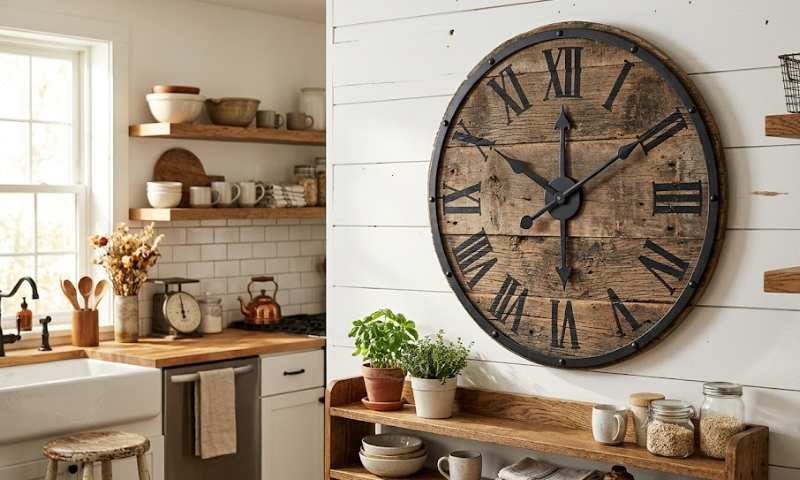
What Type of Wall Clock Is Best for a Home?
Sustainable wood options like FSC-certified walnut and oak showcase natural grains and organic shapes that promote biophilic design principles, with metal-wood hybrids softening urban environments while reducing environmental impact.
For most homes, the best wall clock satisfies four practical requirements before style becomes the primary decision:
Material durability. Solid wood consistently outperforms MDF, fiberboard, and engineered wood in long-term display applications — the natural material doesn’t warp or delaminate the way composite materials can over years of temperature and humidity fluctuation. When a product description says “wood,” confirm whether that means solid wood, MDF with a wood veneer, or fiberboard with a printed wood-look surface, since these perform very differently over a clock’s lifespan.
Movement type. Silent sweep movement is increasingly the standard expectation for living room clocks — and this matters especially for wooden clocks, where the resonance of a wooden frame can actually amplify step-movement ticking compared to a solid metal case of the same size.
Size proportionality. A clock should cover 30–40% of the visible wall width for correct visual proportion — applying this to farmhouse settings means matching the clock’s diameter to the specific wall and furniture arrangement rather than choosing on size alone.
Legibility from the room’s typical viewing distance. A farmhouse clock with highly decorative styling can be beautiful up close and illegible from across the room — confirm that hour markers and hands are clear from 10–15 feet for functional daily use.
How Much Does a Wooden Clock Cost?
The pricing range for wooden farmhouse wall clocks spans significantly depending on construction quality, wood type, and size. A practical breakdown across the market:
Budget tier ($15–$50)
MDF or fiberboard core with printed wood-look or thin wood veneer finish, plastic mechanism, minimal or no warranty. Suitable for temporary or lower-traffic spaces like powder rooms or covered porches.
Mid-range ($50–$150)
Most popular farmhouse wooden wall clocks in this range feature real wood faces or frames, silent sweep quartz movements, and metal hand accents that read as genuinely rustic rather than costume. This tier covers the widest variety of styles and the most reliable quality-to-price ratio for living rooms and kitchens.
Premium ($150–$400)
Solid wood construction, quality quartz movement, often larger formats (28–36 inches), hand-painted or hand-distressed finishes, and better hardware throughout. Solid wood rustic farmhouse clocks from specialty makers run $389–$399 for premium oversized versions made with genuine solid wood and antiqued metal accents.
Artisan/Custom ($400+)
Hand-crafted pieces using reclaimed wood, custom sizing, hand-applied distressing, and artisan finishing. These are functional art objects as much as timekeeping devices.
What Are the Different Styles of Wooden Rustic Farmhouse Clocks?
Distressed Wood with Roman Numerals
The most classic farmhouse clock style — a painted or stained wood face in white, cream, gray, or black with hand-applied distressing that creates a worn, aged appearance, paired with Roman numeral hour markers and spade-style hands. Complements traditional farmhouse, shiplap, and country-style interiors most naturally.
Natural Grain with Metal Hoop Frame
A clean natural wood face — often walnut, oak, or pine showing full visible grain — set within an open metal ring frame in black or bronze. The natural woodgrain texture contrasts nicely against black Roman numeral hour markers and spade hands. This style bridges rustic and contemporary aesthetics, working in transitional, Japandi, and modern farmhouse interiors.
Shiplap Face
A clock face made to replicate or incorporate actual shiplap paneling — horizontal boards in white or natural wood creating the same paneling pattern found on farmhouse accent walls. A direct reference to the shiplap aesthetic popularized in American farmhouse design.
Wood Pallet Style
Constructed to resemble reclaimed pallet wood — often featuring visible plank lines, nail holes, weathered grain, and rough-cut edge treatments that give the face a genuinely repurposed material feel.
Barnwood and Reclaimed Wood
Using actual reclaimed or barnwood-finished timber, these clocks carry authentic age marks — saw marks, nail holes, weathering variation — that can’t be fully replicated in manufactured distressed finishes. Most common in artisan and custom-made pieces at premium price points.
Railway Station / Vintage Industrial Wood
A hybrid style combining a wood body or frame with large, bold station-clock typography, metal hardware, and vintage station clock proportions — referencing the large public clocks found in old railway stations rather than domestic farmhouse settings. Vintage style pieces feature a burnished brown or black wooden case with a distressed white dial that adds just the right amount of contrast.
Live Edge and Natural Form
Using live-edge wood slices where the clock face follows the natural outer boundary of the wood rather than a cut circle — each piece is unique to the specific tree slice. Increasingly popular in 2026’s biophilic design trend.
What Are the Latest Trends in Large Wall Clock Design for 2026?
The overarching shift in 2026 wall clock trends favors oversized statement pieces that command attention, mid-century influences reinterpreted for modern sensibilities, mixed materials creating texture and visual interest, and functional art that serves practical purposes.
Specifically for wooden farmhouse clocks, the 2026 trends most relevant to this style:
Biophilic Wood and Sustainable Materials
The surge in eco-friendly wall clock materials reflects growing environmental consciousness, with sustainable wood options like FSC-certified walnut and oak showcasing natural grains and organic shapes that promote biophilic design principles. Buyers are increasingly asking about wood sourcing and certification, and makers are responding with explicit sustainable sourcing claims.
Natural Grain Over Painted Distressed
While distressed white and gray painted finishes remain popular, natural grain wood faces showing the actual wood’s character are growing faster — a move toward authentic material expression over manufactured “aged” appearance.
Wood and Metal Hybrid Combinations
Metal-wood hybrids that soften urban environments while reducing environmental impact are strong in 2026 — specifically, pairing warm natural wood faces with matte black or dark bronze metal rings, hands, and numeral markers for contrast.
Oversized Formats
Sizes over 24 inches are rising fast, filling blank spots on tall walls in open living spaces — and this applies directly to farmhouse wooden clocks, where larger formats are being used to anchor living rooms and kitchen dining areas.
What Are the Trending Wall Clocks for 2026?
Within the rustic farmhouse wooden category specifically, several design directions are generating the most current interest:
Natural Walnut or Oak Face with Open Metal Ring
Clean visible grain, no paint or heavy distressing, an open thin metal ring frame in matte black or dark bronze, minimal or no numerals. This direction takes the farmhouse wooden aesthetic into Japandi and modern farmhouse territory where it works in more contemporary rooms.
Oversized White Distressed Roman Numeral
The classic farmhouse clock scaled up — distressed white paint, large Roman numerals, 24–36 inch diameter. Every farmhouse home could use a characterful wall clock to bring vintage charm, like a design built from solid wood with black Roman numeral hour markers and spade hands that contrast nicely against natural woodgrain.
Wood and Rattan Mixed-Material
A newer hybrid format combining wood construction with rattan or woven accents — referencing coastal farmhouse and boho-farmhouse crossover aesthetics gaining momentum in 2026.
Laser-Cut Wood Design Details
Clock faces incorporating all-wood laser-cut designs like the “Tree of Life” pattern in the center, surrounded by a metal inner ring with Roman numerals — bridging functional timekeeping with decorative woodworking craftsmanship.
How to Choose the Right Rustic Farmhouse Wooden Clock: Step-by-Step
- Confirm solid wood vs. MDF before purchasing. Check the product description for “solid wood,” “MDF core,” or “fiberboard” — the material classification directly affects durability and how the piece ages.
- Confirm silent sweep movement. Look for “silent,” “non-ticking,” or “sweep movement” in the listing — farmhouse wooden frames can amplify ticking, making this more important than with solid metal clocks.
- Match the finish treatment to the room’s existing wood tones. A distressed white clock in a room with natural walnut furniture creates visual competition; matching warm tones or complementary contrast produces more cohesive results.
- Scale to your wall and furniture. Follow the two-thirds rule — the clock’s diameter should be roughly two-thirds the width of the furniture below it.
- Check battery compartment accessibility. At larger sizes, confirm the battery slot is accessible without fully dismounting the clock from the wall.
Common Mistakes When Buying a Rustic Farmhouse Wooden Wall Clock
- Assuming “wood” means solid wood — most budget farmhouse clocks use MDF or engineered wood with a wood-look finish; solid wood construction requires explicit confirmation in the product description.
- Skipping the movement type check — wooden frames can amplify step-movement ticking in ways solid metal frames don’t, making silent sweep movement a higher priority for wooden clocks.
- Choosing distressed white in a room with cool undertones — distressed white farmhouse clocks carry warm, creamy undertones that can clash with true white walls or cool-toned modern interiors.
- Overscaling for small farmhouse spaces — a 36-inch rustic clock in a small farmhouse kitchen reads as overwhelming rather than charming; 18–24 inches typically suits kitchen and small room applications better.
- Prioritizing decorative appeal over legibility — highly distressed, faded, or decoratively complex faces that look beautiful in a product photo can be genuinely hard to read across a room in daily use.
Wrapping Up
A rustic farmhouse wooden wall clock works because it combines two things most home decor can’t: practical function and honest, warm material character that improves with age. Choosing solid wood over composite, confirming silent movement, and matching finish to the room’s existing tones are the decisions that matter most — everything else is a style preference that the broad farmhouse wooden category accommodates in almost every direction.
Frequently Asked Questions
What type of wall clock is best for a home?
For most homes, a clock with solid wood construction (rather than MDF), silent sweep non-ticking movement, a size that covers 30–40% of the wall width, and a finish that coordinates with existing room materials delivers the best combination of durability, comfort, and visual impact.
How much does a wooden clock cost?
Budget wooden farmhouse clocks run $15–$50 (MDF construction), mid-range quality pieces run $50–$150 (real wood faces, quality movement), premium solid wood options run $150–$400, and artisan or custom reclaimed wood pieces go $400 and above.
What are the different styles of wooden clocks?
The main rustic farmhouse wooden clock styles are distressed wood with Roman numerals, natural grain with metal hoop frame, shiplap face, wood pallet style, reclaimed barnwood, railway station vintage, and live-edge natural form — each suited to different room aesthetics within the broader farmhouse category.
What are the latest trends in large wall clock design?
The dominant 2026 trends relevant to wooden farmhouse clocks are biophilic sustainable wood materials, natural grain over painted distressed finishes, wood and metal hybrid combinations, oversized formats filling tall walls, and mixed-material wood-rattan crossovers.
What are the trending wall clocks for 2026?
Within the farmhouse wooden category, natural walnut or oak faces with open matte black metal rings, oversized distressed white Roman numeral clocks, wood-and-rattan hybrid mixed materials, and laser-cut wood design detail clocks are generating the most current interest.
